Degreasing
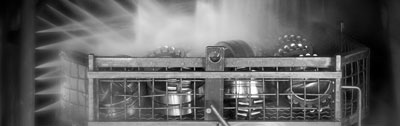
Degreasing is a key process step for removing fats, oils, lubricants, and other organic residues from metal surfaces.
Clean surfaces are essential for ensuring optimal adhesion of subsequent coatings, paints, or adhesives, and also help improve corrosion resistance.
Hot degreasing uses additional heat to liquefy fats and oils and remove them more quickly. When combined with ultrasonics, even stubborn residues are reliably dissolved, leaving the surface uniform and residue-free.
In ultrasonic degreasing, components are treated with high-frequency vibrations during a hot degreasing process. The resulting cavitation bubbles thoroughly remove contaminants even from the smallest pores and cavities.
In electrolytic degreasing, cleaning takes place in an electrolytic bath under a controlled current flow. The resulting hydrogen or oxygen gas dissolves organic residues and leaves behind residue-free, uniform surfaces that are ideally prepared for subsequent processing steps. This process is used especially where the highest standards of cleanliness and surface quality are required.
Technical Specifications
- Colorless
- same look
- Dimensions
Aluminum parts: 2000 x 600 x 1500 mm
Titanium: 440 x 400 x 100 mm
Stainless steel: 700 x 440 x 700 mm - Weight: 250 kg
Additional Options
- Crack Inspection (External)
Non-Destructive Testing (NDT) - Inspection - Factory Test Certificate in accordance with DIN 10204
2.1 Factory Certificate
Standards & Guidelines
- LN 9368-0020
- LN 9368-0021
- LN 9368-0023
- LN 9368-0030
- LN 9368-0031
- DIN 65079
- DIN 65473
- 80-T-35-0020
- 80-T-35-0023
- AIPS_09-01-003