Passivating Stainless Steel
The passivation of stainless steel is a chemical treatment process designed to improve the natural corrosion resistance of stainless steels. During this process, metallic impurities—particularly free iron—are removed from the surface, and the formation of a protective passive layer is specifically promoted.
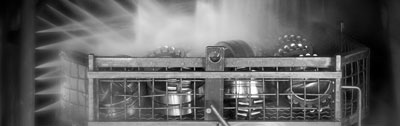
Due to its chromium content, stainless steel has the ability to form a very thin, stable protective layer of chromium oxide on its surface. This so-called passive layer protects the material from corrosion and regenerates itself automatically in the presence of oxygen if damaged. However, during machining—such as turning, milling, or grinding—iron particles or other residues may remain on the surface, which can impair corrosion resistance. During passivation, the components are treated in specially formulated acid solutions. This dissolves and removes foreign metals and surface contaminants. At the same time, it promotes the formation of a uniform and stable passive layer on the stainless steel surface.
The result is a clean, metallically pure surface with significantly improved corrosion resistance. Passivation does not alter the dimensional accuracy or the mechanical properties of the workpiece and is therefore particularly suitable for precision components. The process is used in a wide variety of fields, such as mechanical and plant engineering, medical technology, the food and pharmaceutical industries, the military sector, and aerospace.
Technical Specifications
- passive
- dimensionally stable
- abrasion-resistant
- Visually stunning
- corrosion-resistant
- Properties of Precious Metals
Our Services
- Passivate only completely
- Dimensions 750 x 400 x 600 mm
- Weight 250 kg
- Framed, Woven, and Drum-Woven Goods
- austenitic stainless steels
- austenitic chromium-nickel steels
- martensitic, ferritic steels
- High-temperature-resistant nickel alloys
Additional Options
- Mechanical Machining: Cylindrical Grinding
(Internal and External) (External) - Pre-treatment: Pickling
- Post-treatment
Hydrogen removal
LN 9368-3300
Pickling and, if necessary, passivation of stainless and austenitic steel
- LN 9368-0104
- 80-T-35-0104
- LN 9368-1200
- ASTM 967-5 Nitric 2
- DIN EN 2516 C2
- LN 29747-1
- 80-T-35-1200
- HAP-2048
- ASTM A380-06 and ASTM A967M
Passivation of martensitic and ferritic corrosion-resistant steels (pickling according to 80-T-35-0194 + citric acid)
- LN 9368-0194
- LN 9368-1201
- LN 29747-1
- ASTM A380
- ASTM A967
- DIN EN 2516 C2